Gum disease is the leading cause of adult tooth loss in the United States, yet most cases develop quietly over years of small, compounding errors in daily care. Bleeding gums get dismissed. Flossing gets skipped. And the gap between what people think they’re doing and what’s actually happening at the gum line is often wider than they realize. Getting that gap right isn’t about adding more steps — it’s about understanding which steps matter most, in what order, and why cutting corners on any of them creates a problem that compounds silently until it becomes expensive to reverse.
Where Most Routines Break Down
The standard advice — brush twice, floss daily — is correct in principle but too vague to actually protect gum tissue over time. Most people brush for under 45 seconds when the American Dental Association recommends two full minutes. That alone leaves the gum line undertreated on most visits.
Technique matters as much as timing. Brushing with a scrubbing motion damages the gingival margin — the delicate tissue where the gum meets the tooth — and can cause recession over time. A soft-bristled brush angled at 45 degrees toward the gum line, using short circular strokes, removes plaque at the margin without traumatizing the tissue. An electric toothbrush with a pressure sensor removes the guesswork almost entirely, which is why clinical research consistently shows they outperform manual brushing for plaque reduction.
Toothpaste choice also gets underweighted. For most adults, fluoride toothpaste at 1,000-1,450 ppm strengthens enamel effectively. But for those already showing early gum inflammation, an antibacterial formula containing stannous fluoride addresses both issues simultaneously. The tradeoff is cost — these formulas typically run $8-$12 per tube versus $3-$5 for standard fluoride options — but for someone managing gingivitis, the difference in outcome justifies it.
Flossing, Interdental Tools, and the Real Comparison
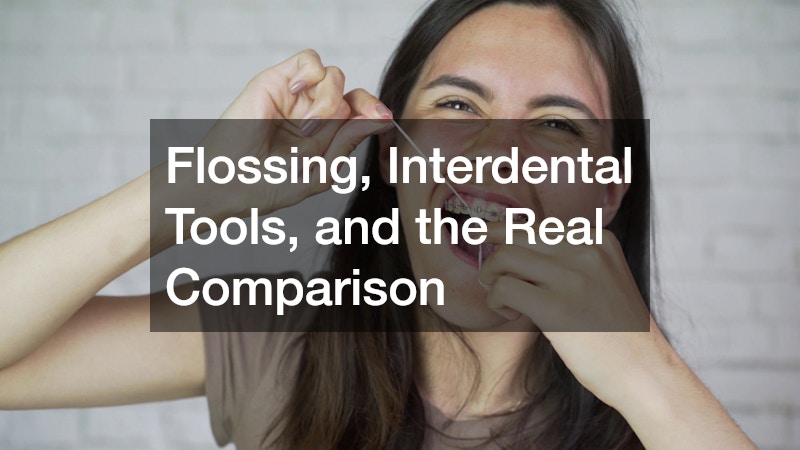
The debate around flossing has become muddier than it needs to be. Some studies have questioned flossing’s direct effect on gum disease outcomes, but the underlying reason to floss has never changed: toothbrushes don’t reach the proximal surfaces between teeth, and plaque left there triggers the inflammation cycle at the gum line.
The more useful question isn’t whether to clean between teeth — it’s how. Standard string floss requires technique most people never learn properly. The floss needs to curve around each tooth in a C-shape and slide gently beneath the gum line, not snap back and forth at the contact point. Done correctly, it’s highly effective. Done incorrectly, it either misses the plaque or irritates the tissue.
Interdental brushes — small bottle-brush-style tools that thread between teeth — are now recommended as the primary tool by several European periodontal guidelines when the spaces are wide enough to accommodate them. They remove more plaque from proximal surfaces than string floss in many cases, and users tend to maintain consistent daily use more readily. Water flossers are a strong alternative for people with braces, bridges, or limited dexterity, but they work differently — they flush debris rather than physically disrupting biofilm, which makes them better used alongside rather than instead of mechanical interproximal cleaning.
The practical guidance: use whichever tool you will actually use every day. A water flosser used consistently outperforms string floss used three times a week.
Rinsing, Diet Timing, and What Happens Overnight
Mouthwash occupies a strange space in most people’s routines — either skipped entirely or used as a substitute for brushing when running late. Neither approach takes advantage of what it actually does well.
Therapeutic rinses containing chlorhexidine reduce the bacterial load associated with gum disease and are often prescribed for short-term use after periodontal treatment. Alcohol-free antiseptic rinses with cetylpyridinium chloride offer a lower-intensity daily option without the dry-mouth side effect that alcohol-based products cause. Cosmetic rinses — the kind marketed primarily for fresh breath — do very little for gum health and aren’t worth the spend if gum tissue is the concern.
Timing matters more than most people realize. Rinsing immediately after brushing washes away the concentrated fluoride sitting on enamel, reducing its remineralizing effect. Waiting 30 minutes, or using mouthwash at a separate time such as after lunch, preserves the benefit. This is a widely misunderstood sequence that genuinely affects outcomes.
Diet also shapes the overnight gum environment significantly. Fermentable carbohydrates consumed in the hour before bed — crackers, fruit, anything with sugar — feed the bacterial population that works undisturbed for seven or eight hours. Finishing eating at least an hour before sleep and brushing after that final meal reduces the overnight bacterial load that the gum tissue faces. Professional teeth cleaning at regular intervals clears calculus that no home routine can remove, but the daily overnight window is where home care either reinforces or undermines that baseline.
Consistency vs. Intensity — The Long-Term Trade-Off
There’s a persistent assumption that an intense but irregular approach — thorough brushing and flossing a few times a week — produces similar results to a consistent daily habit. The microbiology of gum disease doesn’t support this. Plaque matures into a more adherent biofilm within 24-48 hours. Breaking that cycle requires daily disruption, not periodic deep cleaning.
The more realistic question for most adults is how to build consistency rather than how to optimize any single session. Attaching oral care to an existing habit — always after morning coffee, always before a shower — removes the decision-making load that causes skipping.
For people with identified gum disease risk factors — diabetes, smoking history, certain medications that cause dry mouth or gum overgrowth — the daily routine should be framed as active disease management, not maintenance. These individuals typically need professional evaluation every three to four months rather than twice yearly, and their home routine may need specific product adjustments recommended by a periodontist.
The common mistake at this stage is treating the professional appointment as the primary intervention and home care as optional. In reality, it’s inverted: daily home care is the constant, and professional visits are the checkpoint.
Making a Routine That Holds
A gum-protective daily routine isn’t built from the most elaborate tools — it’s built from the right steps executed reliably. Brush for two full minutes with a soft-bristled brush at the gum line. Clean between teeth with whichever interdental tool you’ll use daily. Time your rinse separately from brushing. Cut down on late-night carbohydrates that feed the overnight bacterial cycle. Recognize that risk factors like diabetes or dry-mouth medications shift what “enough” actually means for your situation.
None of this is complicated in isolation. The challenge is that gum disease gives almost no short-term feedback when a routine fails — pain and visible damage tend to appear only after years of accumulated damage. Building the habit now, before there’s a visible reason to, is the decision that determines long-term outcomes.
About the Author