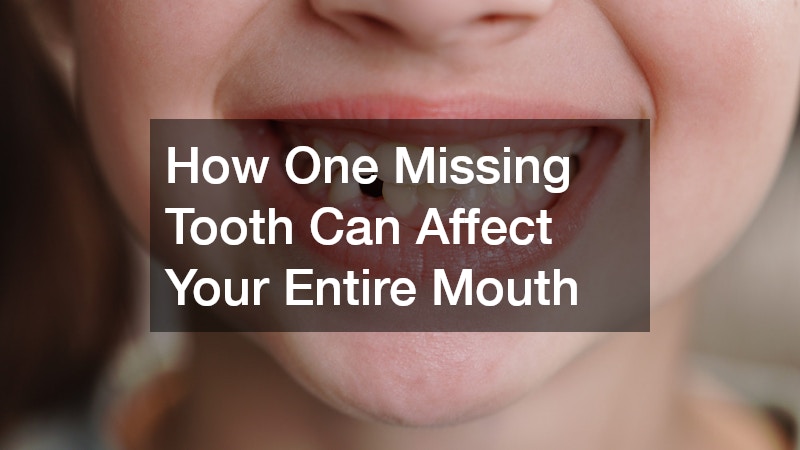
A missing tooth is easy to rationalize away — especially when it’s toward the back of the mouth where no one can see it. It doesn’t hurt. You can still eat, more or less. But the body doesn’t pause while you decide what to do, and the changes that begin almost immediately after a tooth is lost are both structural and cumulative. What starts as a gap in your smile can quietly become a much larger problem affecting your jaw, your remaining teeth, and your overall health.
The Bone Loss That Starts Within Weeks
The jaw bone exists, in large part, because tooth roots stimulate it. Every time you chew, roots transmit force into the surrounding bone, signaling the body to maintain that tissue. Remove the tooth, remove the signal. Within the first few months after extraction or loss, the bone beneath the gap begins to resorb — breaking down and shrinking in a process that is gradual but relentless.
Studies published through the American Academy of Implant Dentistry and related institutions have documented that patients can lose up to 25% of the bone width at a missing tooth site within the first year alone. After three years, that figure climbs significantly. This isn’t cosmetic — shrinking bone changes the foundation that any future restoration would need to anchor into. Patients who wait several years before seeking treatment often discover their replacement options have narrowed considerably, or that a bone grafting procedure is now required before anything else can happen, adding thousands of dollars and several months to what could have been a more straightforward case.
How Neighboring Teeth Respond to Empty Space
Teeth do not stay where they are when a neighbor disappears. The tooth directly opposite the gap — on the other jaw — loses its contact point and begins to erupt, slowly pushing further out of the gumline in a process called super-eruption. Meanwhile, adjacent teeth start to tilt into the open space. Neither movement happens overnight, but both are measurable within six months and clinically significant within a year or two.
The consequence is a cascade effect. Tilted teeth create new pockets where plaque accumulates and is difficult to reach with a toothbrush. They develop uneven contact with opposing teeth, which generates abnormal bite forces. Those forces, distributed incorrectly, place stress on the jaw joint. At this stage, the original problem — one missing tooth — has become a bite alignment issue, a periodontal hygiene issue, and potentially a temporomandibular joint (TMJ) issue simultaneously.
The practical takeaway: the longer you wait, the more comprehensive the treatment plan becomes. Correcting a tilted tooth often requires orthodontic work before a replacement can be placed. That’s a timeline and cost that could have been avoided.
The Chewing Pattern Nobody Notices Until It Hurts
When a tooth is missing, you adapt without thinking about it. You shift food to the other side, you favor certain textures, you stop biting into things the way you used to. This unconscious compensation redistributes chewing load across the remaining teeth in ways they were never designed to handle.
Over time, the teeth absorbing extra force show accelerated wear on their enamel surfaces. Patients who lose a molar and do nothing for several years often present with visible wear facets on the opposite side of the mouth — evidence that those teeth have been carrying double the workload. Beyond wear, the overloaded side becomes more susceptible to fractures, cracking under bite forces that a full complement of teeth would have spread evenly.
There’s also a nutritional dimension worth acknowledging. Research from the Journal of Dental Research and similar publications has linked significant tooth loss — particularly multiple missing posterior teeth — to reduced dietary variety and lower intake of fresh fruits and vegetables, as people unconsciously avoid foods that require substantial chewing. A single missing tooth rarely drives this outcome on its own, but it contributes to a pattern, particularly when combined with other dental issues.
Replacement Timing and What Each Option Involves
The decision to replace a missing tooth isn’t simply whether to act — it’s when, and with what. The three main options are dental implants, fixed bridges, and removable partial dentures. Each carries different timing implications, cost ranges, and long-term trade-offs.
Implants are generally considered the most structurally sound solution because they replace the root as well as the crown, which means bone stimulation continues. A standard single implant typically costs between $3,000 and $5,000 in the US, including the crown, and requires adequate bone volume — which is why waiting too long can disqualify a patient from this option without prior grafting. The process takes three to six months from placement to final restoration.
A fixed bridge spans the gap by anchoring to the adjacent teeth, which are filed down to serve as supports. The cost generally runs $2,500 to $6,000 depending on materials and the number of teeth involved. No surgery is required, but the adjacent teeth are permanently altered — a trade-off that deserves serious consideration when those teeth are otherwise healthy.
Removable partial appliances are the most affordable entry point, often ranging from $1,500 to $3,000, but they don’t address bone loss and require more daily maintenance. Timing relative to bone condition still matters here, because significant resorption changes the fit of any removable appliance over time, requiring periodic relining.
The clearest guidance is to consult a dentist within four to six weeks of losing a tooth, before bone loss becomes a complicating factor, rather than treating it as a decision that can wait indefinitely.
The Connection to Overall Health
Dental research over the past two decades has built a consistent body of evidence connecting chronic oral health issues — including untreated tooth loss — to systemic health outcomes. The relationship between periodontal disease and cardiovascular health is the most studied, with the American Heart Association acknowledging an association, though causality remains an area of ongoing research.
What is clearer is the mechanical and inflammatory link. Gaps left untreated collect bacteria more readily. Bone resorption and shifting teeth make thorough cleaning harder. Over time, low-grade gum inflammation in these areas contributes to the bacterial load the body is managing. For patients who already have conditions like diabetes — where immune response is already compromised — this compounding effect is more than theoretical.
When Inaction Becomes the Most Expensive Choice
The cost of a dental implant feels significant in the moment. The cost of addressing bone loss, correcting two tilted adjacent teeth orthodontically, treating the gum disease that developed in the process, and then placing a restoration after all of that — which is where delayed cases often end up — is considerably higher. Comprehensive reconstructive cases involving multiple complications can reach $10,000 to $20,000 or more.
Acting within the first three to six months of tooth loss preserves the most options at the lowest overall cost. Waiting a year or two narrows those options. Waiting five or more years can make certain solutions technically impossible without major preparatory procedures. The gap itself is never the whole story — it’s what happens to the surrounding anatomy during the delay that determines how complex treatment ultimately becomes.
Making the Decision Before Your Options Narrow
If you’ve lost a tooth recently, the most useful thing to understand is that the situation is not stable — it is actively changing, even when nothing seems to be happening. Booking a consultation within the first month or two doesn’t commit you to any particular treatment path. What it does is give you a clear picture of your bone levels, the condition of adjacent teeth, and the full range of options still available. That information becomes more valuable — and the options more limited — with every month that passes.
About the Author