
You bite down, feel a rough edge with your tongue, and glance in the mirror to find a small chip on your tooth. There’s no pain, no sensitivity, nothing that screams emergency, so it’s tempting to file it away as a cosmetic annoyance and move on with your day. But a painless chip can hide structural weakness that worsens over time, and understanding why matters before you decide to ignore it. This article breaks down what’s really happening beneath that chip and why prompt attention protects your smile for the long run.
Why Nerve Pain Is Not a Reliable Warning Sign
Tooth enamel has no nerve endings, which means a chip limited to that outer layer often produces zero sensation. You could run your tongue over the rough edge, see the chip in a mirror, and still feel completely normal while eating or drinking. That absence of pain feels reassuring, but it’s really just a reflection of enamel’s design, not a measure of how minor the damage is. Pain usually only shows up once damage reaches the dentin or pulp, the inner layers packed with nerves and blood vessels. Dentin is more porous than enamel, so once it’s exposed, temperature changes and sugary foods can trigger sharp, sudden twinges. If the fracture goes deeper still and reaches the pulp, the discomfort can range from mild sensitivity to throbbing pain, depending on whether the nerve is irritated or already infected. This delay creates a false sense of security, because the absence of discomfort says nothing about how deep the fracture actually goes. A chip can look small on the surface while a hidden crack line runs further into the tooth, invisible until it’s probed or X-rayed. In some cases, weeks or months pass before enough bacteria seep into the crack to cause an infection, by which point the damage is far more advanced than the original chip suggested.
Many people assume that if something hurt, they’d know about it immediately, but teeth do not work that way. The outer layer of enamel has no nerve endings, so a crack can exist entirely within enamel and dentin without triggering any signal at all. Pain typically only shows up once a fracture reaches the pulp, the soft tissue deep inside the tooth where nerves and blood vessels live — and by then, the damage is far more extensive. A hairline crack can extend below the visible chip and continue spreading with every bite, all while feeling completely normal. Chewing forces on molars can reach 150 to 250 pounds of pressure, and each bite can act like a wedge, driving an existing crack deeper without any noticeable discomfort. Temperature changes from hot coffee or ice water can also stress a compromised tooth invisibly, widening the fracture line over weeks or months. Waiting for pain before seeking care means waiting until the problem has already advanced significantly. At that stage, a simple bonding or filling may no longer be enough, and the tooth might require a crown or even root canal therapy. What could have been a 20-minute repair early on can turn into a multi-visit, more costly procedure simply because the warning system people rely on — pain — never showed up in time.
What a Small Chip Can Do to Surrounding Structure
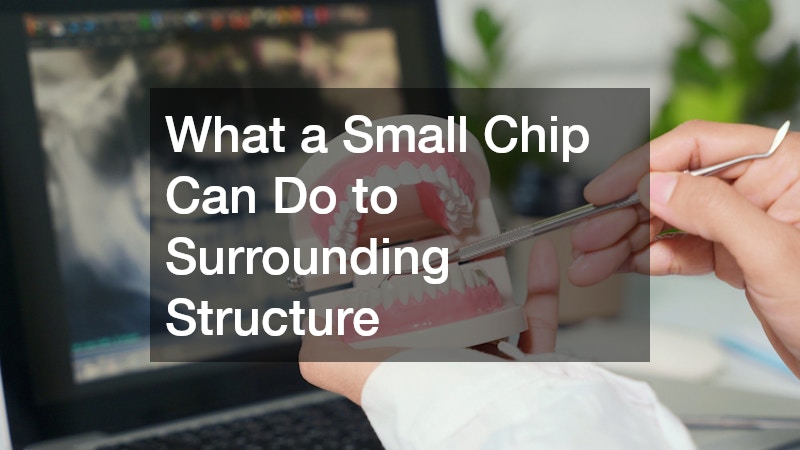
A chipped tooth changes how force gets distributed every time you chew, which puts uneven pressure on the remaining enamel and the teeth next to it. Instead of spreading bite force evenly across a smooth surface, that pressure now concentrates at the rough edge of the chip, turning a small flaw into a stress point every time you eat something firm. Over weeks or months, that imbalance can cause the crack to lengthen, the edge to crumble further, or nearby teeth to shift slightly to compensate. A chip near the biting surface, for example, can extend downward into the dentin, where it’s closer to the nerve and far more sensitive to temperature and pressure. Even chips that seem cosmetic can create a rough edge that traps plaque, raising the risk of decay right at the site of the damage. Neighboring teeth aren’t immune either. As you unconsciously favor the uninjured side of your mouth, the teeth doing extra work can develop their own wear patterns, while the tooth next to the chip may drift slightly out of alignment over time. The result is often a bigger, more expensive problem than the original chip ever was — one that involves a filling, crown, or even root canal instead of a simple polish or bonding.
- Sharp edges can irritate the tongue, cheek, or gum tissue with repeated contact, sometimes causing small sores that won’t heal until the edge is smoothed
- Uneven biting surfaces may lead to jaw strain, muscle soreness, or headaches over time as your bite shifts to avoid the chip
- Bacteria can collect in the rough or jagged area, raising decay risk since brushing often can’t fully reach the fracture line
- A weakened tooth is more prone to breaking further under normal chewing force, especially with hard foods like nuts or ice
- Cracks can gradually extend below the gumline, where damage is harder to detect and treat
- Nearby teeth may take on extra pressure to compensate, increasing their wear over months or years
How Bacteria Exploit a Chip You Cannot Feel
Even a shallow chip creates a rough surface and tiny grooves that are far easier for plaque and bacteria to cling to than smooth enamel. Regular brushing may not fully clean these irregular areas, especially if the chip is on a back tooth or along the gumline. Over time, this buildup raises the risk of cavities forming right at the site of the damage, often before any sensitivity develops.
This is one reason dental professionals recommend having any chip evaluated rather than just monitoring it at home. An exam can reveal whether decay has already started forming in the fracture line, something that is nearly impossible to detect on your own with a mirror and a flashlight. Catching this early usually means a simpler, less invasive fix.
When a Same Week Dental Visit Makes Sense
Not every chip requires an emergency appointment, but most benefit from being looked at within a week or two rather than being left indefinitely. A visit to your family dentist allows for a proper assessment using tools like dental X-rays, which can show fracture depth and nerve proximity that the naked eye simply cannot detect. This is especially important for chips on molars, since back teeth absorb the most chewing force and are harder to monitor yourself.
- Chips near the gumline or on a tooth with a prior filling deserve quicker attention
- Any chip accompanied by a rough edge you keep biting or catching your tongue on should be checked soon
- Chips that expose a yellowish layer beneath the white enamel may involve the dentin
- If a piece of the tooth is missing rather than just cracked, get it evaluated promptly
How Location Makes It Easy to Find Reliable Care
One advantage of dealing with a chipped tooth is that treatment for it doesn’t require a specialist right away, making a local dentist a convenient first stop for evaluation. Staying close to home also makes it easier to schedule a quick follow-up visit if the tooth needs monitoring or a small restoration like bonding. Choosing a nearby practice means less disruption to your schedule, which makes people more likely to actually go rather than keep postponing care.
Consistency also matters here, since a provider who already has your dental history and prior X-rays on file can spot changes in the chipped tooth more easily than someone seeing it for the first time. This kind of continuity often leads to faster, more accurate assessments. It also means fewer repeated questions and paperwork, which makes the whole process smoother.
Restoring Both Function and Appearance After a Chip
Fixing a chipped tooth is not just about looks, though appearance is often what motivates people to finally book an appointment. The right treatment depends largely on how much enamel was lost and where the chip sits on the tooth. A tiny nick on the edge of a front tooth might need nothing more than smoothing and polishing to eliminate the rough spot. For slightly larger chips, bonding is often the go-to solution. This involves applying a tooth-colored resin to the damaged area, shaping it, and hardening it with a curing light, all typically completed in a single visit for under an hour. It’s a budget-friendly option, though the material can wear down over five to ten years and may eventually need touch-ups. When a chip affects a larger portion of the tooth or involves a front tooth where aesthetics matter most, veneers become a popular choice. These thin shells of porcelain or composite cover the entire front surface, masking not just the chip but also discoloration or minor misalignment. For teeth with significant structural damage, particularly molars that endure heavy chewing forces, a crown may be necessary to fully encase and protect what remains. Many people are surprised to learn that cosmetic dentists handle these repairs regularly, blending durability with a natural-looking result that matches the surrounding teeth. Shade-matching technology and impression-taking allow these restorations to blend seamlessly, so the repair is nearly undetectable even up close.
- Bonding uses a tooth-colored resin to rebuild small to moderate chips and can typically be completed in a single visit with little to no downtime
- Bonding is a good fit for minor edge chips or cosmetic imperfections, though it’s less durable than other options and may need touch-ups every 5-10 years
- Veneers may be recommended for chips on front teeth where appearance is a bigger priority, since they cover the entire visible surface for a uniform look
- Veneers require some enamel removal beforehand and are custom-made, so this option usually takes two visits to complete
- Crowns are generally reserved for chips that involve a larger portion of the tooth structure or extend closer to the nerve, offering full coverage and added strength
- A crown may also be paired with a root canal if the chip has exposed or threatened the tooth’s inner pulp
- Follow-up visits help confirm the repair is holding up well under normal biting force and allow your dentist to catch any rough edges or shifting before they become bigger problems
A chipped tooth that feels fine is still a tooth that has lost part of its natural defense system, and that gap only tends to grow if it’s ignored. Getting it checked promptly protects against deeper cracks, decay, and unnecessary tooth loss down the road. Book an appointment soon, describe exactly what you noticed and when, and let a professional confirm whether it’s a quick fix or something that needs closer monitoring.
About the Author